
The Institute was founded on May 31st 1947 on the basis of a Decree on the Institutes of the Serbian Academy of Sciences and Arts, under the name of the Geographical Institute. Since 1961, it has been operating under the name of the Geographical Institute “Jovan Cvijić” of the Serbian Academy of Sciences and Arts.
History
FOUNDING OF THE INSTITUTE
At the initiative of Academician Petar S. Jovanović and with the support of a large number of professors from the University of Belgrade, on November 18, 1946, a letter was submitted to the Serbian Academy of Sciences explaining the need for the establishment of the Geographical-Geological Institute of the Serbian Academy of Sciences. The letter stated:
“The Geographical-Geological Institute would conduct research into scientific problems in geography, geology, and related sciences that also deal with issues concerning the Earth and its population. These sciences include meteorology, climatology, hydrography, limnology, mineralogy, petrography, etc. This Institute would consist of two main departments, the Geographical and the Geological Departments, between which there should be full cooperation, since the scientific problems to be studied within them complement each other and partly overlap.”
(Petar S. Jovanović, Letter to the Serbian Academy of Sciences, Archive of the Serbian Academy of Sciences and Arts)
At the Fifth Session of the Department of Natural Sciences of the Serbian Academy of Sciences, held on March 11, 1947, the proposal of Petar S. Jovanović, Corresponding Member of the Serbian Academy of Sciences, for the establishment of the Geographical Institute was considered.
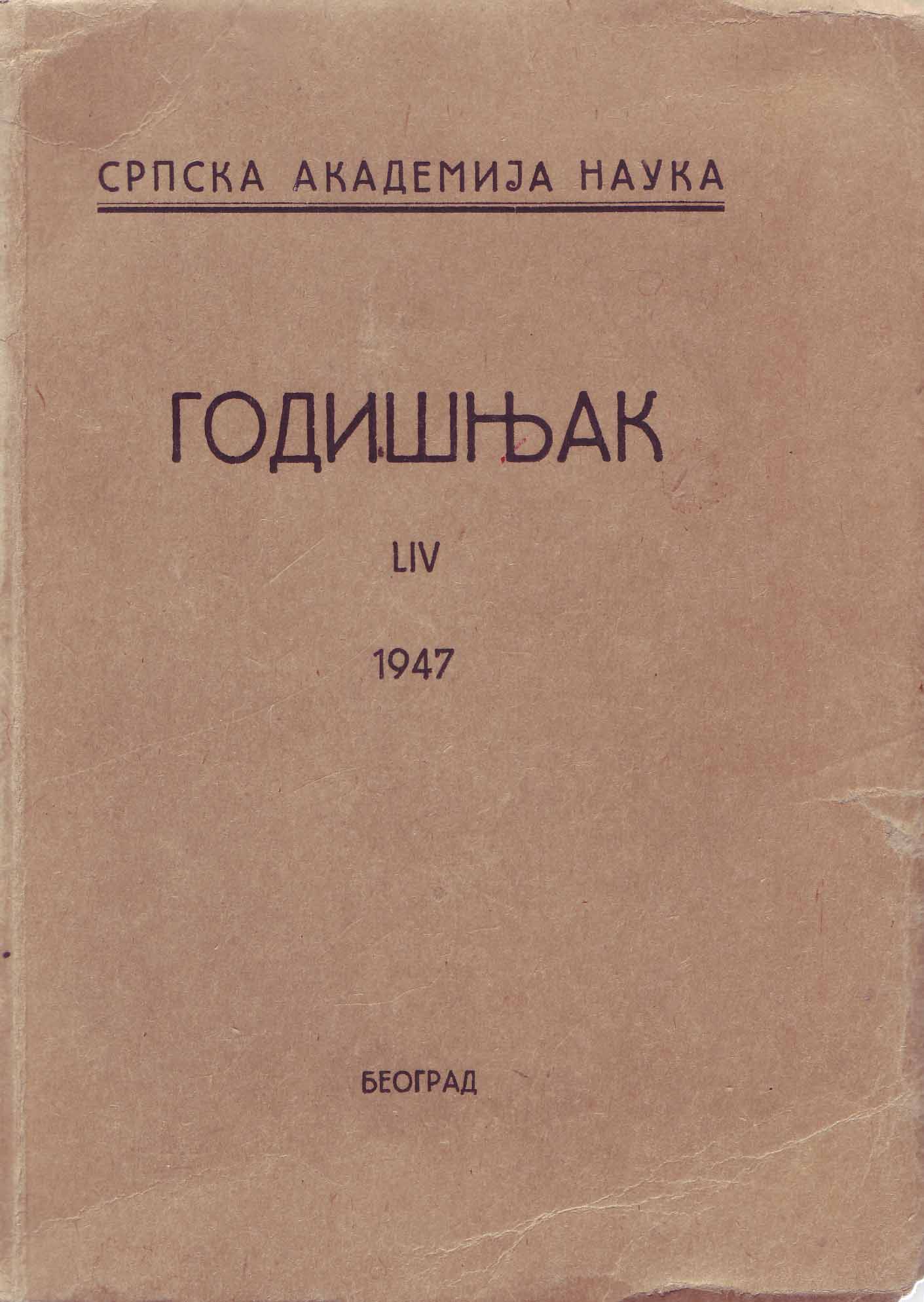
After he presented in detail the general programme for the future work of the Geographical Institute, a decision was made to establish the Institute. At the Seventh Session of the Department of Natural Sciences of the Serbian Academy of Sciences, held on March 13, 1947, the Regulations of the Geographical Institute were adopted. By the Decree on the Institutes of the Serbian Academy of Sciences (Yearbook of the Serbian Academy of Sciences, No. 54, 1947, pp. 30–31), the Geographical Institute of the Serbian Academy of Sciences was officially established on May 31, 1947.
PERIOD 1947 - 1966.
Immediately after its establishment, the management of the Geographical Institute was entrusted to Academician Petar S. Jovanović, who remained at the head of the Institute until his death, for a full ten years. During this period, he successfully established the organization of scientific research activities within the Institute, employed a large number of highly qualified researchers, and achieved notable scientific results.
Regarding the methodological organization of research within the Institute, priority was given to fundamental scientific research of a theoretical-problem-oriented and regional character, as well as, within the available possibilities, applied research. During this period, in addition to the director, the Institute had eight honorary associates: Prof. Dr. Vojislav Radovanović and General Stefan Bošković (Corresponding Members of the Serbian Academy of Sciences), Dr. Borivoje Ž. Milojević, Dr. Pavle Vujević, Dr. Sima Milojević (university professors), Dr. Branislav Bukurov (Professor at the Higher Pedagogical School), Stevan Vujadinović (Curator of the Ethnographic Museum), Antonije Lazić (cartographer), and three scholarship holders: Branislav Jovanović, Nebojša Carić, and Radenko Lazarević.
The first meeting of the Institute’s members was held on June 16, 1947. By the end of 1947, the first field investigations organized by the Institute were carried out, while at the end of the year the Institute also received its first premises and equipment for use. Already in the following year, 1948, specialized research departments were established within the Institute: the Department of Physical Geography, the Department of Human Geography, the Department of Regional Geography, and the Cartographic Department. The results of field research were presented at plenary meetings held within the Institute.
The work of the Geographical Institute was described in detail in its first five-year report (1947–1952, Archive of the “Jovan Cvijić” Geographical Institute of the Serbian Academy of Sciences and Arts). By 1951, the Institute’s human resources had expanded, and in that year it had 11 permanently employed researchers, four members of the Serbian Academy of Sciences, one honorary scientific associate, three honorary professional associates, three external collaborators, and two cartographers. The strengthening of the Institute’s personnel continued, and during the period from 1951 to 1957, 21 researchers, five external research associates, and four auxiliary administrative employees were actively engaged at the Institute (Bjeljac et al., 2017).
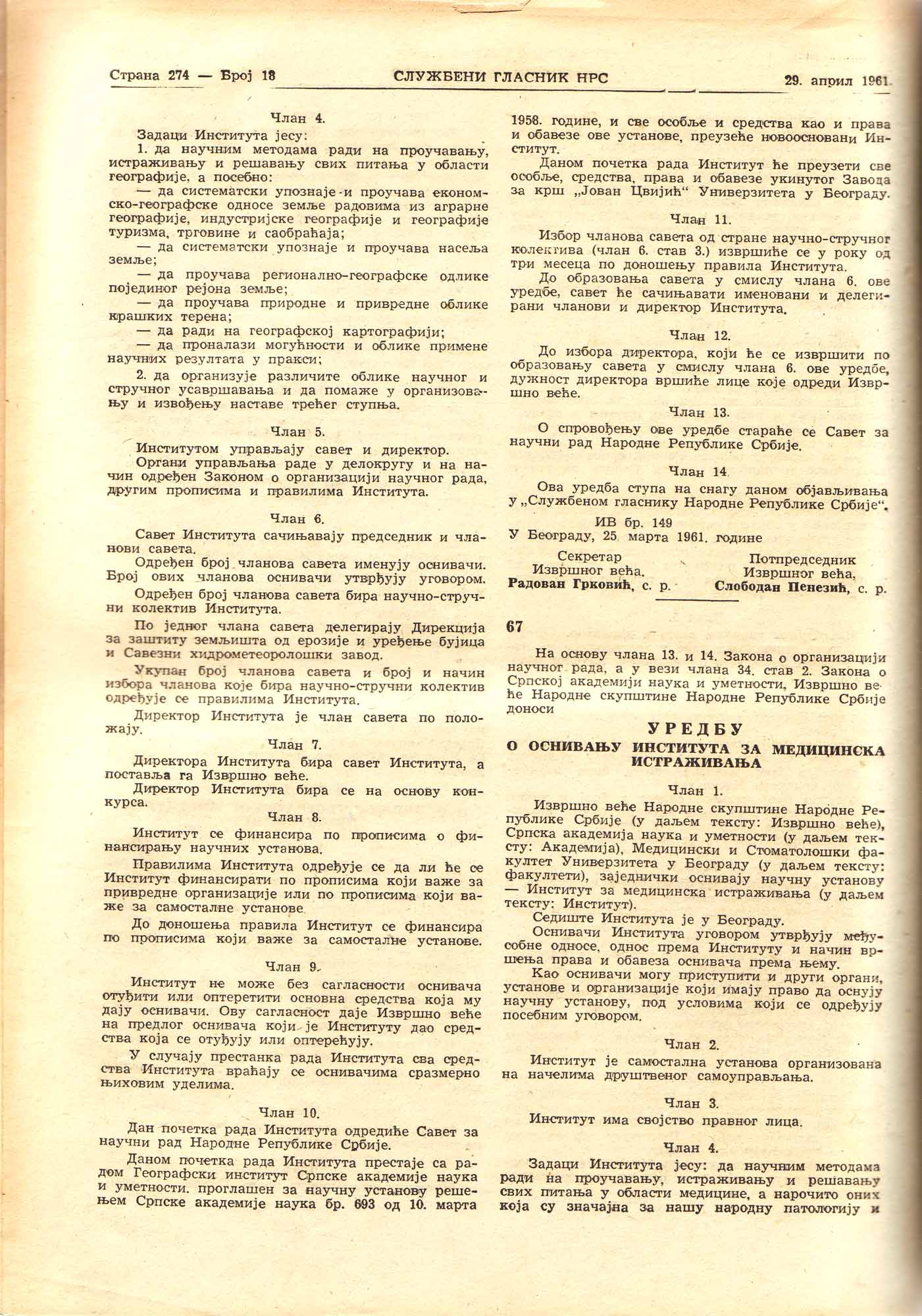
Until 1961, the Institute operated as part of the Serbian Academy of Sciences and was financed through the state budget. At the same time, the Geographical Institute underwent reorganization by taking over all personnel, assets, rights, and obligations of the abolished “Jovan Cvijić” Karst Research Institute of the University of Belgrade (Official Gazette 18/61, dated April 29, 1961). Following this reorganization, it received its new name: the “Jovan Cvijić” Geographical Institute of the Serbian Academy of Sciences and Arts.

PERIOD 1967- 1986.
The period in question was marked by a drastic decline in the number of employees at the Institute, with the scientific staff being almost halved. Consequently, research activities were conducted in accordance with significantly reduced personnel capacities, involving only about ten researchers. However, this period was characterized by a notable diversification of research topics carried out within the Institute. In addition to general physical-geographical studies, greater attention was devoted to economic issues and specialized economic activities, particularly topics related to agricultural geography and tourism geography.
Besides their fundamental scientific significance, applied research activities were also placed in focus. These were conducted for the needs of various state institutions and economic entities in different fields of social practice, as reflected in a larger number of expert, comprehensive, and thematic studies concerning the development of specific spatial units, environmental protection studies, spatial plans, development strategies, and similar projects. During the same period, the Institute also became an independent organizer of national and federal scientific conferences, attended by geographers from across the territory of the former Socialist Federal Republic of Yugoslavia, as well as participants from abroad.
A significant advancement was also achieved in terms of international scientific cooperation and the publishing activities of the Institute, particularly through the periodic publication of the Proceedings of the Geographical Institute (the first 18 volumes), 16 scientific monographs published within the Special Publications series, as well as 10 thematic geographical maps.
PERIOD 1987 - 2006.
During the period from 1987 to 1992, the scientific community lost three academician geographers: Branislav Bukurov, Milisav Lutovac, and Anastasije Urošević. As a result, geography as a scientific discipline within the Academy found itself in an unequal position compared to other scientific fields, as well as in relation to other geographical institutions. This led to the transfer of part of the staff from the Geographical Institute to other institutions.
Through the great efforts of Dr. Miloš Zeremski and other associates of the Geographical Institute, as well as with the arrival of new personnel, a new phase in the Institute’s development began after the 1990s. In 1996, the Institute changed its premises, moving from the building of the Serbian Academy of Sciences and Arts (Knez Mihailova Street No. 35) to the third floor of the building at Đure Jakšića Street No. 9, while the Institute’s library was relocated to the ground floor of the same building. The same building also housed the Institute for the Serbian Language of the Serbian Academy of Sciences and Arts (first and second floors) and the Historical Museum (fourth floor).
With this relocation, the available space of the Institute was reduced by one third, significantly affecting the working conditions of its employees. During this period, efforts were made to restore the cartographic department and develop a Geographic Information System (GIS) within the Institute. This was achieved through the transfer of personnel from the Republic Geodetic Authority and the Military Technical Institute in Belgrade, as well as through the acquisition of the first computers, computer equipment, and the necessary technical infrastructure.
During this period, the Institute independently or in cooperation with other institutions organized 17 national and international scientific conferences. The Institute also received numerous national recognitions and awards, both at the institutional and individual levels.
PERIOD 2007 - 2017.
У овом периоду долази до значајног кадровског јачања Института, са 15 научних радника (од чега свега три доктора наука) до чак 44 радника (од чега 24 доктора наука), као и четворо техничких лица. Интензивно се сарађује са међународним институцијама и реализује се девет међународних научних скупова.
Потписују се протоколи о међународној сарадњи са сродним географским научним и образовним институцијама у иностранству, а спроводе се и пројекти билатералне сарадње и међународне размене у погледу истраживачке праксе. Повећава се капацитет и међународни научни допринос и препознатљивост научне делатности Института који се огледа у великом броју публикованих радова у светски признатим публикацијама и чланству у међународним радним телима и националним одборима.
Од 2003. године интензивирана је и сарадња са огранком Српске академије наука и уметности у Новом Саду, отварањем канцеларије за запослене у Географском институту са пребивалиштем у Новом Саду посебним залагањем академика Олге Хаџић која уступа своје просторије на коришћење запосленима у Институту. У наведеном периоду објављено је 26 бројева Зборника радова и 57 научних монографија у едицији Посебна издања (од чега осам у суиздаваштву са другим институцијама), један атлас и шест карата. По издавачкој делатности се посебно истиче 2010. година када је Институт успео да објави чак 12 научних монографија.
Прва веб-презентација Института постављена је 2007. године од када се интензивно врши њено унапређивање, а у новије време се видљивост Института повећава активношћу на научним и друштвеним мрежама ResearchGate, Academia.edu, LinkedIn, Facebook, итд.
ПЕРИОД 2018-2026.
У овом периоду Институт наставља интензиван научни и институционални развој, уз значајно јачање међународне сарадње, пројектних активности и друштвеног утицаја. Реализују се бројни национални и међународни пројекти, укључујући учешће у програму Horizon Europe, мултилатералне истраживачке иницијативе и пројекте из области дигитализације, геоморфологије, културног наслеђа и друштвених трансформација. Интензивирана је сарадња са домаћим и страним институцијама кроз бројне споразуме и меморандуме, укључујући сарадњу са универзитетима у Европи, Русији, САД, Азији и региону, као и са институцијама као што су Универзитет у Нишу, Факултет безбедности Универзитета у Београду и Универзитет Црне Горе. Институт је био организатор и суорганизатор значајних научних скупова, међу којима се издвајају Пети конгрес словенских географа и етнографа (2024), више међународних конференција из области географије, ерозије и заштите животне средине, као и национални научни скуп Трансформација простора Копнене зоне безбедности (2025). У издавачкој делатности настављен је континуитет кроз објављивање посебних издања (8 публикација), као и зборника са научних скупова и осталих издања (5 публикација).
Истраживачки резултати Института добијају све већу међународну видљивост, што се огледа у индексираности Зборник радова Географског института „Јован Цвијић” САНУ у релевантним базама (Scopus–статус Q2 за 2024. и WoS–IF: 0,8 за 2024. годину), те континуираном расту научне продукције. Институт активно доприноси образовању и друштву кроз акредитоване програме стручног усавршавања, развој дигиталних компетенција у настави и пројекте грађанске науке, као и кроз иницијативе у области заштите и промоције природног и културног наслеђа.
Значајан допринос дат је и на међународном нивоу, укључујући подршку иницијативама UNESCO за проглашење Међународног дана пећина и краса (2025). Кадровски капацитет Института остаје стабилан и висококвалификован са 42 запослених (2025. година) од чега 38 истраживача и 4 административно-техничка радника. Истраживаче чини 5 научних саветника, 17 виших научних сарадника, 14 научних сарадника и 2 истраживача-сарадника. Посебно се истиче да је седам истраживача Института добитник награде „Изврсност у науци” – награђивање 10 % најбољих истраживача у држави за период 2024–2026, од стране Министарства науке, технолошког развоја и иновација Републике Србије, што додатно потврђује висок квалитет научног рада.
LEGAL DOCUMENTS
1. Одлука о оснивању Географског института у оквиру Академије, 1947. године. Годишњак САН, бр. 54, 1947. године.

2. Уредба о оснивању Географског института „Јован Цвијић“ САНУ, 1961. године. Службени гласник НРС, бр.18, од 29. априла 1961. године.
CVIJIĆ AND ACADEMICIANS
Јован Цвијић Аутор текста: др Јелена Ћалић
Петар С. Јовановић Аутор текста: др Ана Милановић Пешић
Боривоје Ж. Милојевић Аутор текста: др Александра Спалевић
Војислав С. Радовановић Аутор текста: др Марија Дробњаковић
Стеван П. Бошковић Аутор текста: др Александра Терзић
Павле Вујевић Аутор текста: др Горица Станојевић
Милисав В. Лутовац Аутор текста: др Јована Тодорић
Бранислав Букуров Аутор текста: др Марко Д. Петровић
MANAGERS AND DIRECTORS
1. Petar S. Jovanović, Academician, Head of the Institute 1947-1957
2. Pavle Vujević, Academician Head of the Institute 1957-1961
3. Vladimir Djurić, PhD, Head of the Institute 1961-1962
4. Vučeta Lakić, Head of the Institute 1963-1965
5. Čedomir Milić, PhD, Head of the Institute 1965-1970
6. Milisav V. Lutovac, Academician, Director 1970-1979
7. Dušan Dukić, PhD, Director 1979-1983
8. Miroslav Milojević, PhD, Director 1983-1986
9. Radovan Ršumović, PhD, Director 1986
10. Miloš Zeremski, PhD, Director 1987-1989
11. Aleksandar Veljković, PhD, Director 1989-1991
12. Milovan V. Radovanović, PhD, Director 1991-1994
13. Ljubomir Menković, PhD, Acting Director 1.1–9.30, 1995
14. Milan Bursać, PhD, Director 1995-2006
15. Jasmina Djordjević, PhD, Acting Director 2006-2008
16. Milan Radovanović, PhD, Director from 2008 to the present
AUTHORIAL TEXTS ABOUT THE INSTITUTE
1. Čedomir S. Milić (1967):
Preface – On the Occasion of the Twentieth Anniversary of the Establishment of the Geographical Institute of the Serbian Academy of Sciences and Arts. Collection of Papers of the Geographical Institute “Jovan Cvijić” of the Serbian Academy of Sciences and Arts, vol. 21, pp. VII–IX.
2. Milisav V. Lutovac (1977):
Preface – On the Occasion of the Thirtieth Anniversary of the Establishment of the Geographical Institute “Jovan Cvijić” of the Serbian Academy of Sciences and Arts. Collection of Papers of the Geographical Institute “Jovan Cvijić” of the Serbian Academy of Sciences and Arts, vol. 29, pp. VII–VIII.
3. Miloš Zeremski (1988):
The Forty-fifth Anniversary of the Geographical Institute “Jovan Cvijić” of the Serbian Academy of Sciences and Arts. Collection of Papers of the Geographical Institute “Jovan Cvijić” of the Serbian Academy of Sciences and Arts, vol. 40, pp. 3-9.
4. Milan Bursać (2005):
The Geographical Institute “Jovan Cvijić” of the Serbian Academy of Sciences and Arts. In: Collection of Papers from the Scientific Symposium “Serbia and Contemporary Processes in Europe and the World”. Belgrade: the Faculty of Geography, pp. 29-38.
5. Jasmina Djordjević (2007):
The Geographical Institute “Jovan Cvijić” from Its Foundation Until Today. Collection of Papers of the Geographical Institute “Jovan Cvijić” of the Serbian Academy of Sciences and Arts, vol. 57, pp. 5-12.
6. Vesna Lukić (2007):
Scientific-research Work in the Sphere of Demography at the Geographical Institute “Jovan Cvijić” of the Serbian Academy of Sciences and Arts. Collection of Papers of the Geographical Institute “Jovan Cvijić” of the Serbian Academy of Sciences and Arts, vol. 57, pp. 101–107.
7. Branka Tošić (2007):
Research in the Sphere of Geography of Cities at the Geographical Institute “Jovan Cvijić” of the Serbian Academy of Sciences and Arts. Collection of Papers of the Geographical Institute “Jovan Cvijić” of the Serbian Academy of Sciences and Arts, vol. 57, pp. 261–269.
8. Radmila Miletić (2007):
Economic-geographic Research at the Geographical Institute “Jovan Cvijić” of the Serbian Academy of Sciences and Arts. Collection of Papers of the Geographical Institute “Jovan Cvijić” of the Serbian Academy of Sciences and Arts, vol. 57, pp. 271–280.

