
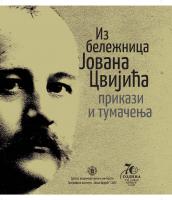
From the Notebooks of Jovan Cvijić – Selected Pages and Interpretations –

Book 94
ISBN 9788670257245

ISBN 978-86-7025-792-4 (SASA)

UDK 978-86-80029-75-7 (GIJC)
Year of publishing: 2019
Authors: Ana Milanović Pešić (Editor-in- Chief), Jelena Ćalić, Marko D. Petrović, Aleksandra Terzić, Zlata Vuksanović-Macura

The publication, entitled “From the Notebooks of Jovan Cvijić – Selected Pages and Interpretations” is the result of cooperation between the Belgrade City Museum and the Geographical Institute “Jovan Cvijić” SASA. It has been prepared with a deep awareness of the importance of Jovan Cvijić’s scientific research work and with the idea to present to the academic and general audiences less familiar details related to the research of Jovan Cvijić, data collecting and the preparation of visual materials, through a carefully organised and thoughtfully and professionally written book. At the beginning of the publication, the Museum of Jovan Cvijić is presented, along with the Legacy containing 42 of his notebooks registered in the inventory. The historical and geographical context of the notebooks is subsequently analyzed in a separate text, followed by an overview of the dominant issues therein elaborated.
The latter part of the publication contains a number of texts accompanying the corresponding original pages from Cvijić’s notebooks. They are written in a concise and structurally equable manner, in order to present selected details about his scientific work and indicate his views and opinions. Furthermore, each text also bears the personal signature of the author, expressed through the interpretation of the selected manuscripts. These texts are from different areas of Cvijić’s scientific work, from the exploration of karst, glaciation, fluvial relief to anthropogeography and ethnographical studies. The texts often contain transcribed segments, with the intention of literally translating Cvijić’s words, as well as providing a direct testimony of his scientific work and private and social life. In terms of their contents, the texts are intended for the professional audience, but in general, they are also understandable to the average educated reader.
A feature of the publication is that it contains the original pages of Jovan Cvijić’s fieldnotes and sketches that have never been published in their original form before. This is a publication with the most comprehensive presentation of this archival material so far.
In 2015, 150 years elapsed since the birth of Jovan Cvijić, and in 2017 marked the 70th anniversary of the founding of the Geographical Institute named after him. This book, originally published in Serbian in 2017 was a modest contribution of the authors and editors to these jubilees. Taking into account the significance of Cvijic’s work at the international level, we considered it very important to publish this book in English in order to make it available to the wider international scientific audience.

Download book in pdf format: Cvijic ENG_selected pages.pdf
 

Small cities – Demographic potential of Serbia

Book 90

ISBN 978-86-80029-69-6

UDK 711.435:314(497.11)
Year of publishing: 2016
Authors: Vlasta Kokotović Kanazir
Editor: Željko Bjeljac

The monograph “The demographic potential of small towns in Serbia” is based on the well-known fact about the uneven and differentiated demographic development of Serbia, which represents one of the fundamental principles of a policy of polycentric development of Serbia and its emphasis as a strategic imperative in the Spatial Development Strategy of the Republic of Serbia (2009). That is why the question of development and the potential of small towns in Serbia is extremely important which implies research of demographic resources and demographic potential, as same as estimation of future demographic trends and population movements in them. Accordingly, the main goal of the monograph is to provide insight into the demographic “state” of urban areas in Serbia, through identification of towns up to 20,000 inhabitants and analysis of demographic indicators, such as population dynamics and population changes, vital parameters, age-sex structure characteristics and migration characteristics. Analytical segment of the monograph includes basic demographic and functional indicators of development, as well as changes in the development of urban settlements. Reached level in demographic development can be shown through identification of changes that have occurred in the redistribution of the population in the settlements, primarily through share of the population inhabited in small urban areas, as indicators of the concentration degree achieved in the given areas.
In recent decades, the Republic of Serbia is characterized by prominent demographic regression. In the last inter-census period (2002-2011.),population development in Serbia recorded extremely unfavorable tendencies, which are reflected in the deepening of the three demographic processes: (1) total depopulation (population decline); (2) natural depopulation (number of deaths exceeds the number of live births), and (3) demographic aging. These processes are particularly noticeable at the settlement level. Since the late 20thcentury, population development of the studied settlements can be classified into several groups according to population dynamics. Among the small towns only a few isolated centers in the Western (Arilje, Bajina Bašta, Kosjerić, Ivanjica, Mali Zvornik) and Central Serbia (Topola, Gornji Milanovac, Subotica) have relatively more dynamic growth. Also, the specific situation is in Vojvodina, where a large number of small towns recorded depopulation for many years. These are the towns of eastern Vojvodina, in contrast to the western regions, where the influx of refugees from the former Yugoslavia contributed to the demographic growth of these urban centers.Small towns are not a unified group and is quite difficult to perform universal
conclusions. There are great differences among the towns which development
category is similar to medium-sized towns and urban settlements that are not municipal centers, as well as among towns which have monofunctional economy
(mining settlements, spa resorts, etc.) and towns with balanced economy development. Several common characteristics of small towns are: this group of settlements have less than 20,000 inhabitants according to 2011 Census and character of urban settlements by statistical and legal criteria; they have a function and importance of the municipal center or supplementary municipal center;
they are in direct contact with the rural environment; and as the most important
characteristic is the role of small towns as the centers of urbanization in rural areas. The role of a small town as a municipal, administrative, economic, cultural and educational center is reflected primarily through establishing appropriate strategies and policy for development at the municipal level. In the future, small towns could be the main driver of demographic revitalization of Serbia. For demographic development is essential to establish appropriate and applicable population policy at the local level in order to utilization of existing human resources.

Tourism on Vršac mountain

Book 89

SBN 978-86-80029-65-8

Year of publishing: 2015
Authors: Željko Bjeljac & Jovan Romelić
Editor: Aleksandra Terzić

Vrsac mountains with their natural and social geographical characteristics represent a significant potential for tourism development, regarding the overall tourist offer of Banat, Vojvodina and Serbia. As borderline mountain range, they are located in the contact zone of the Serbian and Romanian ethnic groups, suggesting the multi-ethnicity of the space and the richness of anthropogenic tourist values. Tourism in this region is based on viniculture and ethnographic richness of the Vrsac mountains.


Development perspectives of the cultural route “Fortresses along the Danube”

Book 88

ISBN 978-86-80029-61-0

Year of publishing: 2014
Authors: Aleksandra Terzić
Editor: Željko Bjeljac

The presentation of cultural heritage through cultural routes and itineraries is in line with the preferences of the Strategy of the tourism development in the Republic of Serbia. Cultural (thematic) routes are presented as the priority axis of the national strategy of tourism development. They are represented in a long list of proposed, preliminary and completed projects based on the creation and promotion of cultural and thematic routes in this region. Strategies for valuation of cultural heritage in line with the cultural route development and revitalization of fortresses in the Republic of Serbia, demand the acknowledgment of their specific importance. They need the
efforts in establishing the sustainability and finding the proper ways in the creation of cultural products. They should enable the fortresses to be revived and experienced by both, residents and tourists. This can be achieved through the incorporation of scientifically developed methods and implementation of specific measures. These must be supported by the government, with an aim of putting the heritage into public use and profit making. It must be done in terms of sustainable development, followed by ensuring the proper management and protection of cultural assets.

Within the Republic of Serbia there is a great number of fortresses and castles from different historical periods. However, most of those sites in Serbia are at the moment in a critical state. They were neglected and ignored by the local communities, the government and the tourism industry for decades. Even though, there is a vast number of fortification remains and fortresses in Serbia. They are mostly categorized in a group of archaeological sites. Among the great number of fortresses in Serbia, potential for becoming the representative tourist attractions, have only a few, the most impressive and the best preserved ones. Fortresses along the Danube in Serbia could represent very important elements in the process of the development of the tourist offer of Serbia in Danube region. Along the Danube in Serbia exists seven greatly preserved fortresses, dating from different historical periods. Fortresses in Bac, Petrovaradin, Belgrade, Smederevo, Ram, Golubac and Kladovo are extremely valuable cultural resources of Serbia. Those fortresses are proclaimed to be the cultural monuments of exceptional or great national value. They are protected by the Law and put into the jurisdiction of the Ministry of Culture of the Republic of Serbia. The care of the fortresses is submitted to the local and regional institutions engaged in the protection of the cultural monuments. The focus of this study is set on the development of the cultural route Fortresses along the Danube in Serbia. It is based on the analysis of the characteristics of the Danube region in Serbia. Focus is set on the analysis of the possibilities of the cultural tourism development in this region. Cultural route in Serbia can be based on cultural heritage and fortresses along the Danube River. They can present key attractions of the route. They will surely effect the creation of the cultural tourist offer in the Danube area and enrich the tourist offer of Serbia.

Download book in pdf format: Book 88 summary.pdf

UV radiation and heat waves in Vojvodina

Book 87

ISBN 978-86-80029-68-9

Year of publishing: 2016
Authors: Slavica Malinović Milićević, Milan Radovanović
Editor: Boško Milovanović

It is an indisputable fact that the Earth’s climate is changing. The observed climate changes have already had a direct impact on the economy, ecosystem and human health, and projections show that these changes will have serious consequences in all parts of the world in the future. The mechanisms by which climate changes directly and indirectly affect the quality of life and health should be thoroughly studied in order to reduce the negative consequences to the lowest possible level. When it comes to the atmosphere, a problem that has marked the last few decades is the increasing concentration of pollutants in the air, which leads to an increase in the intensity of UV radiation and global warming. UV radiation and prolonged periods of intense heat are especially dangerous because they have a direct impact on health, especially in summer, when people spend more time outdoors.

Population change and functional structure of Pančevo

Book 83

ISBN 978-86-80029-53-5

Year of publishing: 2011
Authors: Vesna Lukić
Editor: Željko Bjeljac


The most important factor that affects growth and development of Pančevo is immediate vicinity to Belgrade as administrative and largest economic, cultural and university center of the state. Changes in the demographic development and functional structure of Pančevo and the scope, territorial range, and structure of commuting flows in the urban system of Pančevo were influenced by the following:
– geo-traffic and socio-economic status of Pančevo,
– population dynamics and changes in the spatial distribution of population,
– natural and migration component of demographic development,
– changes in the basic structures of the population (socio-economic and biological),
– changes in the number and basic characteristics of households (size of households according to the number of members, family structure and economic characteristics of households),
– changes in the structure and level of development and diversification of the economy, and
– labor market changes.
The analyses have shown that the retention of the resource of the young population who are first-time job seekers is especially important in the municipality of Pančevo. Encouraging the participation of women in the labor market can positively affect the number of working age population. The development of Pančevo was very much affected by traditionally developed industry, represented in large industrial complexes of a wider national significance. Nowadays manifestation of the reforming processes is visible through the continuing growth of the self-employed as well as a tertiary sector on the account of reduction of the secondary one. Considering the ongoing process of economic transition and rapid development of the market economy, faster growth in the sector of services in relation to the production one will still go on. The reduction in the number of employees in the service sector can only be expected in the sphere of education and health, due to the current transition of the national institutions. The results of testing the influence of demographic and socio-economic factors on the average commute one-way travel length in the urban system of Pančevo shows that women on average have shorter commuting trips than men. This confirms findings in the international literature on this subject on shorter traveling of women to work. Women travel on shorter distances than men who are of the same education, work in the same sector of activity and have the same family characteristic. The influence of education on the average commute one-way travel length is noticeable, although it is more so when speaking about the female population.

Full book in Serbian/ Summary on English

Tourist events in Serbia

Book 82

ISBN 978-86-80029-52-8

Year of publishing: 2010
Authors: Željko Bjeljac
Editor: Ivan B. Popović and Vesna Lukić

Within the tourist offer of Serbia, the event tourism represents a form of tourism that contributes to the increasing extent of tourist demand, especially natural and anthropogenic values of tourist place or region. The event tourism can be defined as a public performance of an event or several events (of the same or different contents) of various categories of human achievements identified according to their particularity and attractiveness, realizing tourist effects and goals, and organised in all settlements that have interest in that, with massive appearance and public expression significant by the extent, size, quality and quantity of the contents and clearly expressed central subject, recognisable term of holding by which the profitability is realized as part of a tourist destination. From the beginning of the 1980s, the event tourism has been mentioned in the world as a separate industry. In Serbia, the event tourism gained significance as an economically prosperous form of tourism by the first half of the first decade of the 21st century. It has been particularly significant that it appeared for the first time in the strategic documents, especially in the Strategy of Tourist Development of Serbia up to 2015. Since a large number of events have been organized in Serbia (especially at the end of the first decade of the 21st century), they needed to be categorized and classified with the aim of identifying those events significant by their attractiveness and attendance, and especially the events that can be the brand of destination. Based on the research, some events in Serbia represent the significant segment of tourist offer an extremely important element in the development of the selective forms of tourism by their long tradition of holding, attractiveness and ambiance of holding, as well as their forged image. Some events, outgrowing the national frames and acquiring a reputation on the international market, are positively differentiated and they become the recognizable brands the attractive power of which increases, while the economic effects rapidly increase the profit realized from tourism.
Full book in Serbian/Summary in English